Safe Emergencies
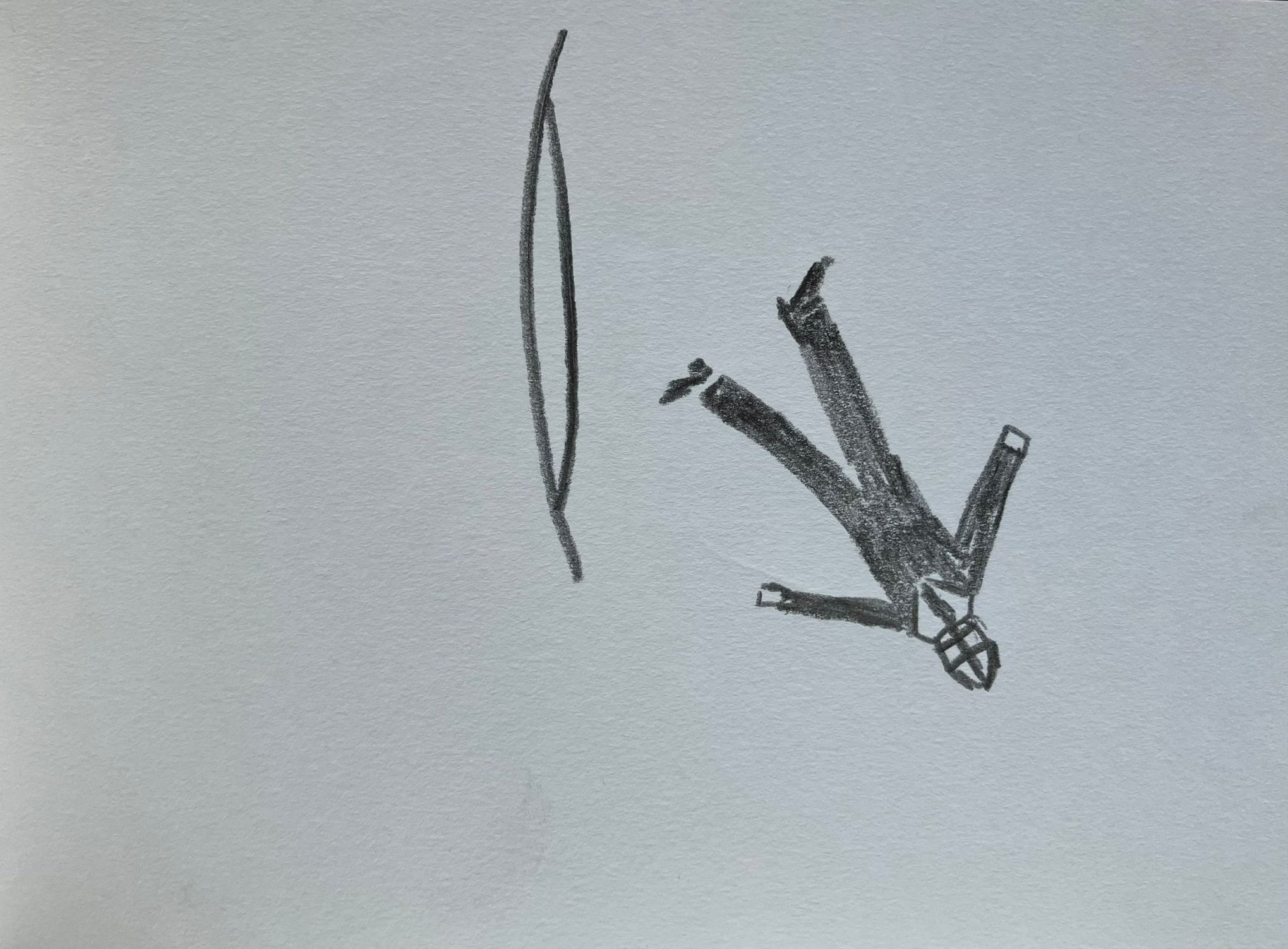
drawing by Ann Course
A Brief History of Gestalt Experiments
Gestalt therapy was born in the middle of the twentieth century out of a kind of creative rebellion. Its founders, Fritz Perls, Laura Perls, Paul Goodman and Ralph Hefferline, were trained in psychoanalysis but had grown impatient with its traditional methods of long silences, the analyst behind the couch, the slow excavation and interpretation of past experience. They wanted something more alive. Something that happened in the present moment, something between two embodied people in a room, that trusted the wisdom of what was actually happening rather than searching elsewhere for its cause.
The book that gathered these ideas, Gestalt Therapy: Excitement and Growth in the Human Personality, published in 1951, set out a strange and beautiful proposition. That change does not come primarily from understanding why we are the way we are. It comes from doing something new while the therapist is paying attention with us. In place of interpretation, the founders centred this process on the experiment.
The etymology of word experiment comes from the Latin experiri, to try. It carries a feeling of tentativeness, of provisional venturing, of seeing what happens. A Gestalt experiment is not a procedure with a known outcome, instead its perhaps closer to what an artist does in the studio or a child does in play. You stay with what is here, you notice something, and then you try a small thing to see what happens. Joseph Zinker, whose 1977 book Creative Process in Gestalt Therapy remains one of the great expressions of the form, called the experiment a way of thinking out loud, a concretisation of one's imagination and a creative adventure. Erving and Miriam Polster, writing in Cleveland in the 1970s, framed it as a way of moving someone's habitual life into bolder relief so that what had been stuck could become workable again. Laura Perls, insisted that any good experiment had to be tailored to the particular person in the particular moment, never a technique applied from above but rather something that arises from the therapist’s intuition and creativity.
The archetypal experiment in Gestalt is the two chairs or empty chair. You sit in one chair and speak as yourself then you move to the empty chair opposite and speak as the other, be it your parent, your boss, the part of yourself you are at war with, even the headache or the cigarette or the dead pet. Then back, and back again and something happens in this small piece of theatre that talking about the relationship rarely achieves. The other becomes vivid and our own evasions become visible. Feelings that may have been were stuck find a body and a direction, everything becomes more alive. Fritz Perls did not entirely invent this, he learned a version of it in the 1950s from Jacob Moreno, the founder of psychodrama whose open sessions in New York he attended for nearly a decade. Moreno had been working with role reversal and enactment since the 1920s, and Perls brought it into Gestalt. The two chairs has since travelled well beyond Gestalt, taken up by emotion focused therapy, schema therapy, transactional analysis and even cognitive behavioural therapy where it is now one of the more researched experiential methods in the field and I’ve written more about its history here.
Most experiments, though, are smaller and more subtle than chair work. They might involve speaking a sentence aloud that you have only ever thought, and noticing what happens in your throat or your eyes when you do. They might involve exaggerating a gesture you keep making, or moving more slowly than you ordinarily would, or letting your foot speak instead of your mouth. They might involve nothing more than placing a hand on your chest and breathing into it for a minute. The form is endlessly variable. What matters is that the experiment is rooted in what is actually happening, and that it is undertaken with curiosity rather than goal.
The aim of all this is ultimately awareness, not introspection or analysis rather the lived, immediate knowing of what is going on in you and around you in this moment. The texture of your breathing, the temperature of the room, the way your body arranges itself, the quality of your contact with the person opposite you, that flicker of feeling that passed through you a moment ago. The goal being that awareness is the precondition of choice and without it we are neurotically stuck in our old patterns, when we step out of it, even briefly, something else becomes possible.
Perls, Hefferline and Goodman wrote that change happens through what they called a safe emergency. This is the moment when something real and a little frightening becomes possible, and it is possible because the situation is held and the stakes are bearable. The experiment is the form this safe emergency takes. It is an invitation to try a small frightening, interesting thing and see what we find.
More than seventy years on this still feels both contemporary and urgent. In a culture saturated with self optimisation and content about the self, the Gestalt experiment makes a quieter and more unusual offer. It does not ask you to know yourself better in the abstract. It asks you to try something now and pay attention. It treats the body as more honest than the explanation, and meaning as something that arises in the doing rather than something to be uncovered through years of thought.
We have made a instagram channel called Safe Emergencies, where we will be posting a series of Gestalt experiments to try out, collated and adapted by me and illustrated by the artist, Ann Course. The experiments are drawn from a long tradition and developed by many Gestalt practitioners. Some are very old, some are more recent, all of them arise from a history of experimenting in the therapy room, in groups and in training. They are offered not as instructions but as invitations and you do not need to be in therapy to try them. You only need a few minutes, a willingness to feel what arises, and a little courage that any safe emergency might demand.
References
Perls, F. (1969). Gestalt Therapy Verbatim. Lafayette, CA: Real People Press.
Perls, F., Hefferline, R. and Goodman, P. (1951). Gestalt Therapy: Excitement and Growth in the Human Personality. New York: Julian Press.
Perls, L. (1992). Living at the Boundary. Highland, NY: The Gestalt Journal Press.
Polster, E. and Polster, M. (1974). Gestalt Therapy Integrated: Contours of Theory and Practice. New York: Vintage.
Zinker, J. (1977). Creative Process in Gestalt Therapy. New York: Brunner/Mazel.
